
Kempower's New Charger Bridges Cars and Trucks on One Site
Authored by jaimelesartistes.info, 20 Sep 2026
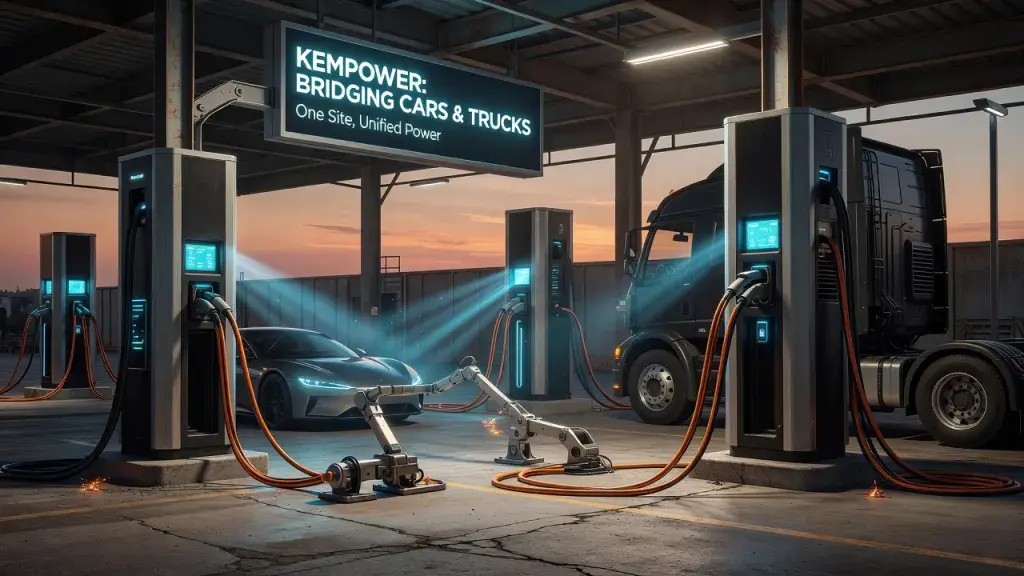
Kempower has introduced a single charging unit capable of serving both passenger electric vehicles and heavy-duty trucks, a design choice that could reshape how charging sites are planned over the next decade. The Mega Satellite Flex delivers up to 560 kW through the established CCS standard and up to 1.2 MW through the emerging Megawatt Charging System, making it the Finnish company's first dispenser built to handle either format from the same cabinet.
The timing reflects a genuine industry inflection point. CCS remains the dominant connector for electric cars across North America and Europe, but it was never engineered for the power demands of long-haul trucking, where vehicles need to recharge massive battery packs in the time it takes a driver to take a mandated rest break. MCS was developed specifically to close that gap, and its rollout is now gathering pace alongside the first generation of heavy-duty electric trucks reaching commercial fleets. For operators trying to decide which standard to build around, or whether to build for both, the details are worth reading before committing capital to a site that might otherwise become obsolete within a few years. the details are worth reading
One Site, Two Charging Standards
The practical appeal of the Mega Satellite Flex lies in avoiding duplicate infrastructure. Historically, a charging site owner wanting to serve both cars and trucks would need separate hardware, separate electrical planning, and often separate physical space for each standard. Kempower's approach folds both into one unit, supporting up to 1,500 amps for MCS and 700 amps for CCS, with cable lengths of 5 meters for CCS and 2.7 meters for MCS. That flexibility also extends to newer 800-volt passenger vehicles, which require higher voltage delivery to fully exploit their faster-charging battery architecture.
For a site operator, this translates into a straightforward business advantage: a single installation can start generating revenue from passenger vehicle traffic immediately, then absorb truck charging demand as electric freight fleets scale up, without a second construction project or a second round of permitting and grid upgrades.
Why Utilization Matters More Than Power Alone
High-power chargers are only valuable if they are actually used. Charging networks have struggled in the past with expensive hardware sitting idle because it was built for a vehicle segment that hadn't yet reached the road in meaningful numbers. By supporting both CCS and MCS on demand, the Mega Satellite Flex is designed to stay productive regardless of which vehicle type dominates traffic at a given location, a factor that directly affects how quickly an operator recovers the capital cost of installation.
The unit is also compatible with Kempower's existing distributed charging architecture, meaning operators already running Kempower systems can add the Flex without rebuilding their power distribution or software integration from scratch. An optional payment terminal rounds out the package for sites serving public or mixed commercial traffic.
What Comes Next
Kempower revealed the Mega Satellite Flex at its Unplug & Recharge event held alongside ACT Expo, a venue closely watched by fleet operators and charging infrastructure planners. The company has set a North American and European launch for July 2026, giving the market roughly a year to prepare sites and financing before the hardware becomes commercially available. Whether other manufacturers follow with similar dual-standard designs may say as much about the pace of MCS adoption as any single product announcement.