
Insurance in Blackjack: When to Take the Insurance Bet, Expected Value, and Does It Pay Out?
Authored by jaimelesartistes.info, 11 Aug 2026
A side bet that loses money on average roughly two out of three times has no business surviving on a casino floor for a century - yet insurance in blackjack has been offered at nearly every table since the game's modern form took shape. The reason is simple: it feels protective. A dealer flashes an ace, the pit boss's voice in your head whispers "cover yourself," and suddenly a bad instinct dressed up as prudence starts costing players money hand after hand.
The math behind this wager is not mysterious. It has been calculated, verified, and taught in every serious card-counting text for decades. Casinos know the numbers too, which is exactly why the bet remains on the layout. If you have ever paused before a dealer's ace and wondered whether to lay down that extra chip, you have already sensed the tension between gut feeling and arithmetic. For a formal breakdown of the mechanics, what is insurance blackjack is worth reviewing before diving into the strategy layer, since the rules governing payout ratios and timing shape everything that follows.
This piece breaks down the blackjack insurance bet from every angle that matters: how it works at the table, what the expected value of insurance bet calculations actually reveal, when the wager stops being a sucker bet and starts being a mathematically sound play, and whether the payout structure is as generous as it appears at first glance.
What Insurance in Blackjack Actually Is
The Mechanics at the Table
Insurance becomes available the moment the dealer's upcard is an ace. Before anyone acts on their hand, the dealer asks players if they want "insurance." Accepting means placing a side bet worth up to half your original wager. If the dealer's hole card is a ten-value card, completing blackjack, insurance pays 2 to 1. If not, the insurance bet is simply lost, and play continues normally with your original hand.
Why It's Called Insurance At All
The name suggests protection, and structurally it functions that way for players holding a blackjack themselves. In that specific scenario, taking insurance guarantees an even-money result regardless of the dealer's hole card - a even payout that some tables offer automatically as "even money." For every other hand, insurance is not protection against loss; it is a separate, isolated wager on a single question: does the dealer have a ten underneath?
How It Differs From Other Side Bets
Unlike perfect pairs or 21+3, insurance connects directly to visible information already on the table - the count of ten-value cards remaining in the deck. That link to observable card composition is what separates insurance from purely speculative side bets and what makes it, uniquely among casino side wagers, exploitable through disciplined counting.
The Expected Value of Insurance Bet: Doing the Math
Standard Deck Composition and the Base Probability
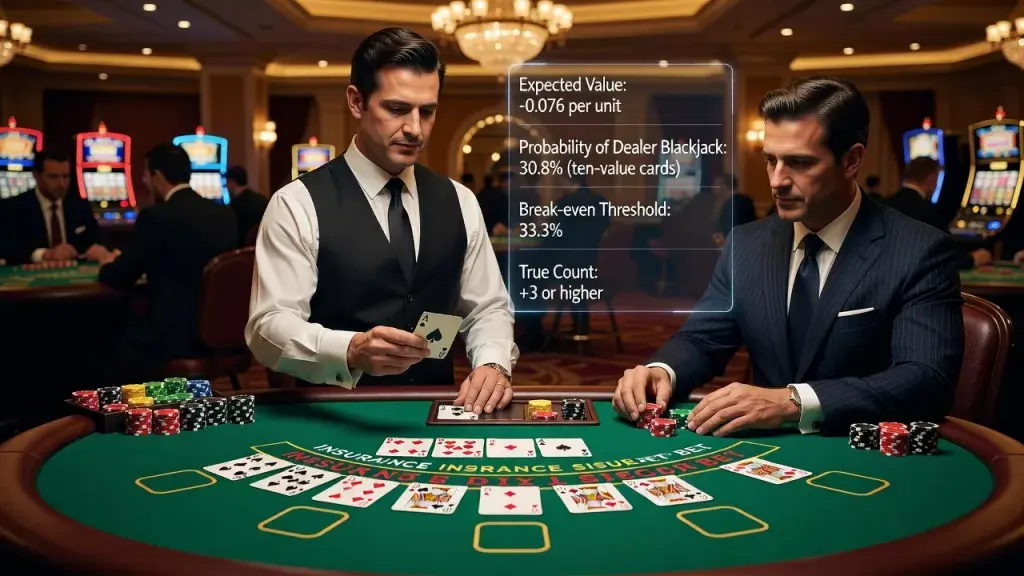
In a freshly shuffled single deck, 16 of the 52 cards are ten-value (tens, jacks, queens, kings), while 36 are not. Once the dealer's ace and your own two cards are removed from consideration, the remaining unseen cards determine the real odds. In a typical six-deck shoe near the start of a round, roughly 30.8% of remaining cards are ten-value - meaning the dealer completes blackjack a little under one time in three.
Calculating the Loss Per Unit Wagered
Assume you bet one unit on insurance. Win 2 units when the dealer has blackjack (probability ~30.8%), lose 1 unit otherwise (probability ~69.2%). The expected value works out to: (0.308 × 2) − (0.692 × 1) = 0.616 − 0.692 = −0.076. That negative figure means for every unit wagered on insurance under standard shoe conditions, a player loses about 7.6 cents on average over time.
Why the House Edge on This Side Bet Is Steeper Than It Looks
Compare that to the house edge on well-played basic-strategy blackjack, often under 1%. Insurance carries an edge many multiples larger under neutral card conditions. The payout ratio of 2 to 1 looks generous next to even-money bets elsewhere on the table, but it only breaks even when ten-value cards make up exactly one-third of the remaining deck - a threshold that rarely holds in an unaltered shoe.
- Ten-value card proportion needed to break even: 33.3%
- Typical proportion in a fresh six-deck shoe: roughly 30.8%
- Resulting average loss per unit bet: roughly 7-8%
When to Take Insurance Blackjack: The Real Decision Rules
The Counting Threshold
Card counters do not evaluate insurance emotionally; they evaluate it against a specific ratio. The break-even point occurs when ten-value cards represent one-third or more of the remaining unseen cards. In Hi-Lo counting terms, this corresponds to a true count of roughly +3 or higher. Below that threshold, declining insurance is mathematically correct regardless of how tempting the ace looks.
Situations Where Insurance Can Be Justified
Late in a shoe that has produced disproportionately few ten-value cards, the remaining deck skews rich in tens, jacks, queens, and kings. When a counter tracks this shift accurately and confirms the true count supports it, taking insurance shifts from a losing proposition to a genuinely profitable one. This is the only scenario where the bet consistently favors the player.
Why Player Instinct Fails Here
Dealers showing an ace trigger anxiety, and anxiety produces poor decisions. Many players take insurance simply because losing a blackjack to a dealer's matching blackjack feels doubly painful. That emotional response has nothing to do with the actual composition of the remaining deck, which is the only variable that matters.
Single-Deck Versus Multi-Deck Considerations
Single-deck games shift faster toward extreme ratios because fewer cards need to be removed to change the proportion significantly. Six- and eight-deck shoes dilute the impact of any few rounds, meaning the deck composition stays closer to neutral for longer stretches, and profitable insurance opportunities arise less frequently and are harder to time.
Does Insurance Pay Out? Understanding the Payout Structure
The 2-to-1 Payout Explained
When the dealer's hole card is a ten-value card, insurance pays 2 to 1 on the side bet. A five-dollar insurance wager returns ten dollars in winnings, plus the original five back. That payout ratio is fixed across virtually all blackjack variants offering the bet, unlike other side wagers with tiered payout tables.
What Happens When the Dealer Doesn't Have Blackjack
If the hole card is anything other than a ten, the insurance wager is forfeited immediately, and the hand proceeds under normal rules - you play your cards against the dealer's upcard as usual, entirely separate from the insurance outcome.
The "Even Money" Variant
When a player holds their own blackjack and the dealer shows an ace, some tables offer "even money" instead of standard insurance. Accepting locks in a 1:1 payout immediately, bypassing the dealer's hole card check entirely. Mathematically, this is identical to taking full insurance on a winning blackjack hand - both produce the same guaranteed even-money result.
Common Misconceptions About the Insurance Bet
"It Protects My Bankroll"
Insurance does not protect anything for a player without their own blackjack. It is an independent wager with its own negative expectation, riding alongside your main hand rather than shielding it.
"The Dealer Showing an Ace Means They Probably Have Blackjack"
An ace upcard alone tells you nothing beyond the base probability of roughly 30-31% in a standard shoe. Without tracking the actual cards already played, there is no informational edge to exploit.
"Taking Insurance Every Time Balances Out Over a Session"
Because the expected value of insurance bet is consistently negative under neutral conditions, repeating the bet across many hands compounds losses rather than balancing them. Volume does not fix a negative-EV wager; it amplifies it.
Practical Guidelines for Players
Basic Strategy Players Without a Count
If you are not actively tracking the ratio of high to low cards, the disciplined choice is to decline insurance on every hand, without exception, including when you hold your own blackjack. The even-money offer is the same negative-EV bet wearing a different name.
Card Counters With a Reliable System
Only accept insurance when your running count translates to a true count of approximately +3 or higher, confirming that ten-value cards remain disproportionately represented in the unseen portion of the shoe.
Recreational Players Seeking Simplicity
For anyone unwilling to track counts, the simplest rule that preserves the most value is a flat "never take insurance" policy. It removes decision fatigue and guarantees you avoid the bet's built-in disadvantage entirely.
- No count tracked: decline insurance always
- True count at +3 or above: insurance becomes profitable
- Holding your own blackjack with no count: even money and insurance are mathematically the same choice
Frequently Asked Questions
Is insurance the same bet as even money?
Yes, when you hold a blackjack yourself. Taking insurance on a winning blackjack hand produces the exact same guaranteed payout as accepting the even-money offer some tables present instead. Both lock in a 1:1 return before the dealer reveals the hole card.
Can basic strategy charts tell me when to take insurance?
Standard basic strategy charts, built for maximizing the main hand, universally recommend declining insurance because they assume no card-counting information. Insurance decisions require tracking the deck's remaining composition, which sits outside the scope of basic strategy entirely.
Why do casinos still offer a bet with such a clear house edge?
Most players decline to track card composition and either avoid insurance or take it based on instinct rather than math, which keeps the bet profitable for the house on average. The rare disciplined counter who exploits favorable ratios represents a small fraction of total insurance wagers placed.
Does the number of decks in play change when I should take insurance?
Yes. Single-deck games shift toward extreme card ratios faster because each card removed has a larger proportional impact, so favorable insurance windows can appear sooner. Multi-deck shoes dilute this effect, requiring a longer stretch of low-card-heavy play before the true count justifies the bet.
Is it ever correct to take insurance without counting cards?
No. Without tracking which cards have already appeared, you have no way to judge whether ten-value cards remain overrepresented in the shoe. Taking insurance blind relies purely on the base probability, which sits below the break-even threshold and favors the house.
What's the difference between insurance and surrender?
Surrender lets you forfeit half your original bet to exit a weak hand entirely, reducing losses on hands you're statistically unlikely to win. Insurance is a separate side wager unrelated to the strength of your hand, betting specifically on whether the dealer's hidden card is a ten-value card.