
Crazy Time: A Fast-Paced Time Travel Action Adventure with Arcade Rhythm Energy
Authored by jaimelesartistes.info, 08 Jul 2026
A ticking clock does more for tension than any monster ever could. Strip away the weapons, the villains, the plot twists, and what remains at the core of the best chaotic adventure titles is a simple mechanism: time running out, and a player racing against it. That mechanism, stretched across shifting eras and unpredictable set pieces, is what gives certain fast-paced action games their addictive pulse. It's also the engine behind a growing category of entertainment that blends cinematic time travel storytelling with the reflex-driven satisfaction of arcade rhythm design.
This combination sounds unlikely on paper. Time travel narratives tend to be cerebral, built on cause-and-effect puzzles and slow-burn revelations. Arcade rhythm games, by contrast, reward split-second timing and muscle memory. Yet when designers fuse the two, something unexpected happens: the philosophical weight of altering history gets paired with the physical thrill of hitting a beat perfectly. Players exploring this space often stumble across the crazy time a game, a title that illustrates how chaotic pacing and structured rhythm can coexist without canceling each other out.
What follows is a breakdown of why this genre works, how its mechanics are built, and what separates a forgettable time-hopping shooter from a genuinely memorable one. Anyone curious about where interactive entertainment is heading - toward faster, denser, more sensory experiences - will find plenty to unpack here.
What Makes a Time Travel Game Feel Genuinely Chaotic
Chaos in game design isn't randomness for its own sake. It's carefully engineered unpredictability that still respects internal logic. A well-built time travel game creates chaos by layering timelines on top of each other, forcing players to track consequences across eras while reacting to threats in real time.
Nonlinear Timelines as a Design Tool
When a narrative allows players to jump between decades or centuries, every choice gains weight. An action taken in one era can lock a door in another, spawn an enemy three centuries later, or erase an ally who hasn't been born yet. This nonlinear structure is what separates a shallow time-travel gimmick from a system with real stakes.
Consequence Loops and Player Agency
The best chaotic adventure game design rewards players for noticing patterns. A mistake in 1920 might resurface as a crisis in 1985. This loop of cause and delayed effect keeps players mentally engaged even during the most frantic combat sequences, because every action carries forward.
Environmental Shifts That Reinforce Disorientation
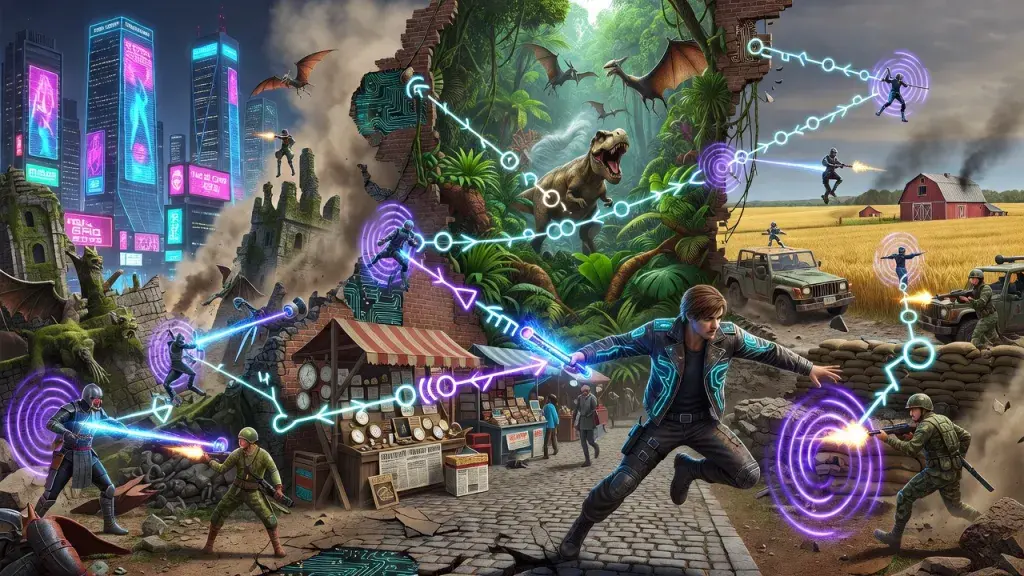
Levels that morph mid-mission - a marketplace collapsing into ruins, a battlefield reverting to farmland - do more than look impressive. They communicate instability, reminding players that the timeline itself is a hostile, shifting variable they must respect.
- Branching timelines that react to specific player decisions
- Environments that visually decay or rebuild as history shifts
- Enemies or allies whose existence depends on earlier choices
The Anatomy of a Fast-Paced Action Game
Speed alone doesn't make a game exciting. Pacing does. A fast-paced action game succeeds when tension escalates deliberately, giving players brief windows to breathe before the next wave of pressure arrives.
Momentum-Based Combat Systems
Combat that rewards continuous movement - dashing, sliding, chaining attacks - keeps players physically invested. Static, cover-based shooting works in other genres, but a title built around speed needs mechanics that punish hesitation and reward forward motion.
Escalation Curves and Difficulty Pacing
A mission that starts at maximum intensity has nowhere to go. Skilled designers build escalation curves: early encounters teach mechanics, mid-game sequences combine them, and late-game set pieces demand mastery of everything learned so far.
Micro-Decisions Under Pressure
Fast games force fast choices. Do you dodge left or right? Reload now or in three seconds? These micro-decisions, repeated hundreds of times per session, are what make the genre feel visceral rather than scripted.
Why Arcade Rhythm Mechanics Elevate the Genre
Rhythm mechanics bring structure to chaos. Where pure action games rely on reflexes alone, an arcade rhythm game introduces a predictable beat pattern that players can internalize, turning combat into something closer to choreography.
Timing as a Skill Layer
When attacks, dodges, or time jumps are tied to a rhythmic cue, skilled players gain a measurable edge. This transforms difficulty from "can you react fast enough" into "can you predict and time your response," a subtler and often more satisfying challenge.
Audio-Visual Feedback Loops
Sound design in rhythm-driven titles isn't decoration. A well-placed beat drop signals an incoming enemy wave; a bass hit might sync with a screen-shaking explosion. This tight audio-visual coupling trains players to react to sound as much as sight.
Flow State and Replayability
Rhythm mechanics are uniquely good at inducing flow state - that immersive feeling where time distorts and focus sharpens. Games that nail this timing layer tend to have far higher replay value, since mastering the beat becomes its own reward.
Crazy Time Game Design: Blending Genres Without Losing Identity
The hardest part of building a crazy time game isn't combining action, rhythm, and time travel - it's making sure none of those elements overshadow the others. Genre blending fails when one mechanic dominates and the rest feel like afterthoughts.
Balancing Narrative Depth with Reflex Gameplay
Story-heavy time travel plots can slow momentum if not paced carefully. Successful hybrid titles deliver narrative beats during natural lulls - after a boss fight, before a new era unlocks - rather than interrupting high-intensity sequences with exposition.
Visual Language That Signals Era and Danger Simultaneously
Color palettes and set design need to do double duty: establishing which time period the player occupies while also communicating threat levels. A neon-lit future zone might signal high enemy density through lighting alone, without a single line of dialogue.
Sound Design That Unifies Disparate Eras
Music has to bridge wildly different visual settings - medieval villages, dystopian cities, prehistoric jungles - without breaking the sense of a cohesive rhythm system. This is often achieved through a consistent beat structure layered under era-specific instrumentation.
Player Psychology: Why Chaotic Adventure Games Hook Us
There's a reason chaotic adventure game formats sustain long-term engagement rather than burning out after a few sessions. The unpredictability triggers dopamine responses similar to those seen in variable-reward systems, but paired with skill-based mastery, which keeps the experience from feeling hollow.
The Appeal of Controlled Unpredictability
Players don't actually want true randomness - they want the feeling of unpredictability within a system they can eventually understand. This is why timeline-based chaos works so well: it appears disordered but rewards pattern recognition over time.
Mastery Through Repetition Under Variable Conditions
Repeating a level with shifted environmental variables teaches adaptability rather than memorization. Players build genuine skill because no two runs feel identical, even when the underlying objective stays the same.
Emotional Stakes Tied to Temporal Consequences
Knowing that a rash decision in one timeline might devastate another era adds emotional weight rarely found in single-timeline action games. This stakes-driven design keeps players invested well beyond the initial novelty of time travel as a concept.
Comparing Crazy Time Game Formats Across the Genre
Not every title labeled a time travel game or arcade rhythm game approaches the formula the same way. Understanding the variations helps clarify what separates strong entries from weaker imitations.
Story-Driven Titles vs. Score-Chasing Arcade Formats
Some games prioritize narrative arcs across eras, using time travel as a storytelling device. Others strip narrative down to nearly nothing, focusing purely on beat-matched combat and leaderboard chasing. Both approaches are valid, but they attract different audiences.
Single-Timeline Chaos vs. Multi-Era Juggling
A single unstable timeline can generate plenty of tension on its own. Multi-era formats, where players juggle three or four periods simultaneously, raise the cognitive load significantly and tend to appeal to players who enjoy systems-heavy challenge.
Casual Arcade Sessions vs. Deep Progression Systems
Some formats are built for short, replayable bursts - ideal for quick sessions. Others layer in progression systems, unlockable abilities, and long-term meta-goals, turning what looks like a simple arcade rhythm game into something with dozens of hours of depth.
- Narrative-first titles with branching time travel plots
- Score-attack formats built around rhythm precision
- Hybrid systems combining light story with deep progression
Frequently Asked Questions
What separates a genuine time travel game from one that just uses the theme as decoration?
A genuine time travel game ties gameplay consequences directly to timeline shifts - actions in one era visibly alter another. If jumping through time changes nothing mechanically and only serves as a backdrop, it's a theme rather than a system.
Do arcade rhythm mechanics make a game harder or easier for newcomers?
Rhythm mechanics generally lower the entry barrier because they give players a predictable pattern to learn, unlike pure reflex challenges that offer no structure. Mastery still takes practice, but the learning curve tends to feel fairer since timing can be studied and improved deliberately.
Why do chaotic adventure games often feel more replayable than linear action titles?
Variable environmental conditions and branching consequences mean no two playthroughs unfold identically. This built-in variation keeps repeated sessions feeling fresh, whereas strictly linear titles tend to lose appeal once the story path is fully known.
Is heavy narrative content a disadvantage in a fast-paced action game?
Not inherently - the issue arises only when story delivery interrupts momentum during high-intensity sequences. Well-paced titles insert narrative beats during natural lulls, preserving both story depth and gameplay speed.
How important is sound design in a game blending rhythm and action elements?
It's central rather than supplementary. Sound cues often signal incoming threats, timing windows, or era transitions, meaning players who ignore audio cues will struggle regardless of visual reaction speed.
Can multi-era gameplay become confusing rather than engaging?
Yes, if the game fails to give players clear visual or narrative anchors distinguishing each timeline. Strong design uses distinct color palettes, music styles, and environmental cues so players always know which era they're currently affecting.